40 Kamoro Women Participated in Local Food Processing Training
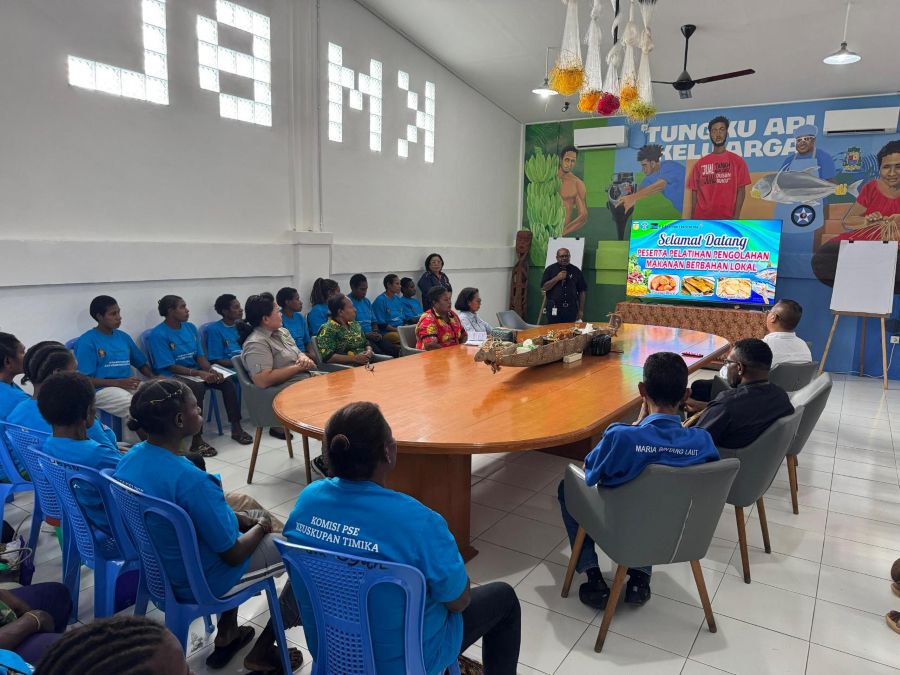
Timika, June 18, 2026 — Forty Kamoro women from eight coastal villages in Mimika participated in local food processing training to increase community capacity in developing a local-based economy. This training was held by the Timika Diocese through the Maria Bintang Laut Cooperative, supported by PT Freeport Indonesia (PTFI) at Rumah Sagu, Timika Diocese Complex, Central Papua, on June 11–12, 2026.
"Through this collaboration, the Kamoro women gained new skills and knowledge and gained more confidence in processing nutritious local food ingredients that can improve the well-being of their families," said Benyamin Meo, Head of the Maria Bintang Laut Cooperative, during the training.
He explained that this training was a continuation of the Economic Program (PRONOMI) IV, which PTFI has been running since 2017 in eight assisted villages: Nawaripi, Koperapoka, Ayuka, Tipuka, Nayaro, Vanamo, Omawita, and Ohotya. This training is expected to optimize the use of local resources, improve family nutritional quality, and strengthen the role of women in community-based economic development in the coastal areas of Mimika Regency.
.jpg)
.jpg)
.jpg)
.jpg)
For two days, Benyamin continued, the mothers learned how to process nutritious local food ingredients from fish, tambelo, cassava, sweet potatoes, coconut, and bananas into lemet, fish crackers, and tambelo crackers. Participants then learned how to process various banana products such as banana molen, nagasari, and banana cake.
One participant from Otakwa village, Erfina Aypapenaei (29), expressed her gratitude for the opportunity to receive the processing training held by PTFI in collaboration with the Timika Diocese. "I learned that we can easily find food ingredients in our villages, like bananas and cassava, into delicious and nutritious meals for our husbands and children at home," said Erfina.
PTFI Senior Vice President (SVP) of Sustainable Development, Nathan Kum stated that this training demonstrates the company's ongoing commitment to promoting the utilization and development of local foods with nutritional and economic value.
"Through this training, we hope that participants can apply the skills they learn at home to their families, then share them with the community in their villages, and encourage more residents to use local food ingredients creatively and productively," Nathan said at the opening of the event.
Yohana Arwam, Head of the Mimika Regency Women's Empowerment, Child Protection, Population Control, and Family Planning Agency (DP3AP2KB), expressed her appreciation for the collaboration between PTFI, the Timika Diocese, and the Mimika Regency Government in increasing the capacity of local women.
"Take advantage of this opportunity to improve your skills in processing nutritious food from readily available local ingredients. Training like this is a concrete step in improving skills while opening up business opportunities based on local potential," she said.
Back To List